
Dealing with AI and Change Fatigue

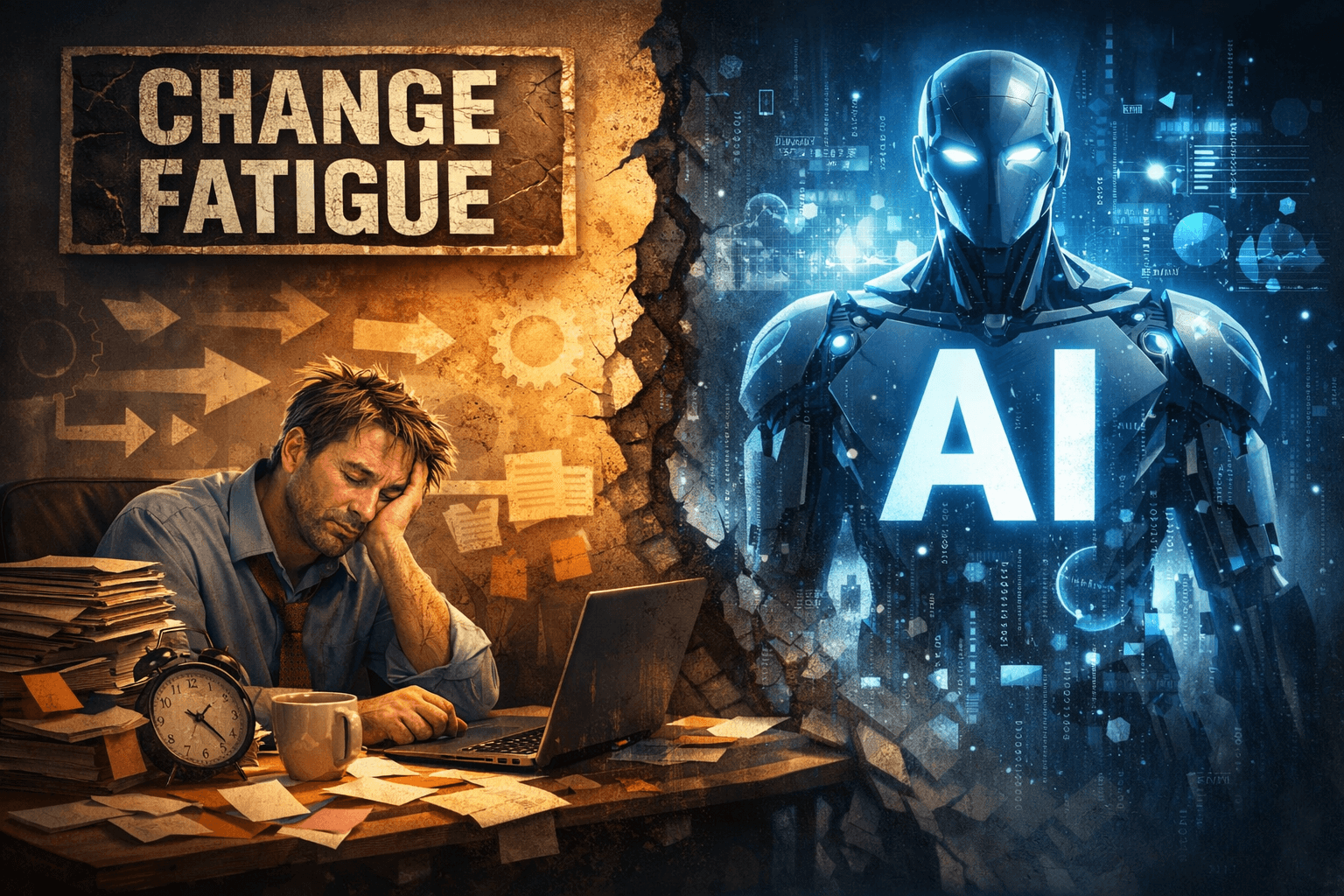
I think one of the biggest challenges that organisations face in implementing AI is the change fatigue it can cause for employees and teams. As someone who works with research and insights organisations on their AI adoption, I see this tension constantly: the pressure to adopt new tools conflicts with people's capacity to absorb change.
We're roughly three years into the current AI revolution (dating from ChatGPT's launch in late 2022), and I believe we have at least five to ten more years of significant change ahead. I am already hearing of change fatigue impacting some teams, and this will get considerably worse if we keep chasing every swing of the AI’s dragon’s tail.
In this post, I want to share some practical approaches for reducing change fatigue while still getting tangible benefits from AI. These come from my experience working with research organisations and insight teams, and from observing what works and what doesn't.
Make Changes Under the Hood (or Bonnet)
Imagine improving a car's performance. You could upgrade the engine, transmission, and braking system whilst keeping the driver's experience largely unchanged. Or you could redesign the entire dashboard and move all the controls. The first approach delivers benefits without requiring users to relearn their skills, the second maximises the need for people to change what they do.
This is what I mean by making changes 'under the hood/bonnet'. Take existing processes and make them work better without requiring users to change their workflow. For market research teams, this might include:
Automated file organisation: After a meeting, notes appear automatically, files are tagged and stored correctly, and summaries are distributed. The outcome is the same; the effort required drops significantly.
Enhanced data checking: Your existing data quality process stays the same from the user's perspective ('check this data file'), but the underlying checks become more thorough and accurate.
Smarter search and retrieval: Finding past projects, reports, or client information becomes faster without requiring users to learn new interfaces.
Keep the Language Familiar
Right now, the AI world is buzzing with terms like 'agents' and 'agentic workflows'. When talking to colleagues about improving how work gets done, I believe it's much better to talk about data preparation, planning, and presentations rather than discussing which agents they'll use or how to make a process more agentic.
There's less cognitive load if we talk to people in a language they already understand. In the research ecosystem, we should be discussing faster fieldwork, better analysis, or clearer reporting, not LLMs and RAG pipelines. Save the technical language for technical discussions with technical people.
Remove Processes Rather Than Changing Them
When we change a process using AI, people must learn how to adapt, how to use the new approach, and how to verify it worked correctly. But if we can actually remove a step entirely, all people need to learn is to stop doing something they used to do. Provided it wasn't a task they enjoyed, that's much easier to absorb.
For research teams, consider whether AI can remove: filling in time-sheets, distributing meeting notes, scheduling coordination, or routine status reporting. If these steps can be handled automatically, most people's working lives improve.
A word of caution: when removing processes, ensure appropriate oversight remains. I'd recommend a transition period where outputs are reviewed before trusting automation completely 😊
Create Intelligent Defaults
AI can make tools more powerful with more options. But most of us don't want to make choices about an enhanced range of options every time we use a tool. Research consistently shows that most users stick with default settings.
The opportunity with AI is to create defaults that are tailored to individuals, their projects, and their clients, through the AI learning from patterns rather than requiring explicit choices. For example, a charting tool might learn that a particular client prefers certain colours and layouts, and apply these automatically for that client's projects.
Don't Implement Every Possible Change
If you try to implement every enhancement every time ChatGPT or Gemini adds a feature, you'll make the rate of change unbearable for your colleagues. When you identify a process improvement that requires user actions (not an 'under the hood/bonnet' change), consider whether the improvement is substantial enough to justify the disruption.
My rough heuristic is that if a visible change delivers only 10-15% improvement, consider waiting until you can deliver 50% or more improvement. Bank the smaller gains and deploy them together in a more significant update.
Focus on What People Actually Want
This is the most important point: focus your AI efforts on the tasks people genuinely want help with. Which processes do your team find hardest or most tedious? Which elements feel most risky? Don't focus on automating tasks people enjoy or identify with professionally.
In research organisations, I find that people typically welcome AI help with data cleaning, routine analysis, and administrative tasks. They're often more protective of tasks like client interaction, strategic interpretation, and creative problem-solving. Respect these preferences where you can.
Where to Start
When I advise an insights team on where to begin, I'd suggest starting with 'under the bonnet' improvements that don't require workflow changes, focusing on tasks people find tedious rather than those they value. Get some wins that demonstrate AI's value without demanding new skills, then gradually expand from there.
What do you think? How are you managing the pace of AI-driven change in your organisation? I'd be interested to hear what's working and what isn't.
Want to Stay Up to Date?
Here are some ways to keep current with AI developments in market research: